
Lyz Bly, Ph.D./DRB (She/they)
August 17, 2024
In 2017, after the orange menace took the election and office, I changed the final paper assignment for my Women’s and Gender Studies introductory course. Previously, I liked ending WGS 151 on a high note–the “Notable Woman Research Interview,” in which students were asked to choose a woman from anywhere in the world and write a question and answer-style paper that they and a partner would “perform” for the class, as if they were on a talk show. The assignment was a fun celebration of women throughout history who made great contributions to the world, and if the group was into it, we would pretend we were the Oprah show and students would volunteer to be the director, time-keeper, lighting expert, etc.

Above: Jayne County, a student’s “Notable Woman Research Interview” subject, circa 2023 (recently, I went back to giving this assignment)
But after the 2016 election, it was clear that survival was surmounting fun, and that meant critical, theoretical analysis from beginning to end on the 151 syllabus. We started with the genocide of witches, midwives, healers, and peasants living in Neckar-Rhine region of Germany, reading a chapter from Silvia Federici’s The Caliban and The Witch: Women, The Body and Primitive Accumulation, which illustrates the ways in which elite white men in Germany have been genocidal since the nascence of capitalism. Federici explains that the genocide of white females, mostly peasants, that began in 1342 was part of a state initiative to force a path toward early mercantilism. This economic shift was reinforced by the church, guild/trade militias, and the courts, all employing propaganda to justify state and church-sanctioned violence. [1]
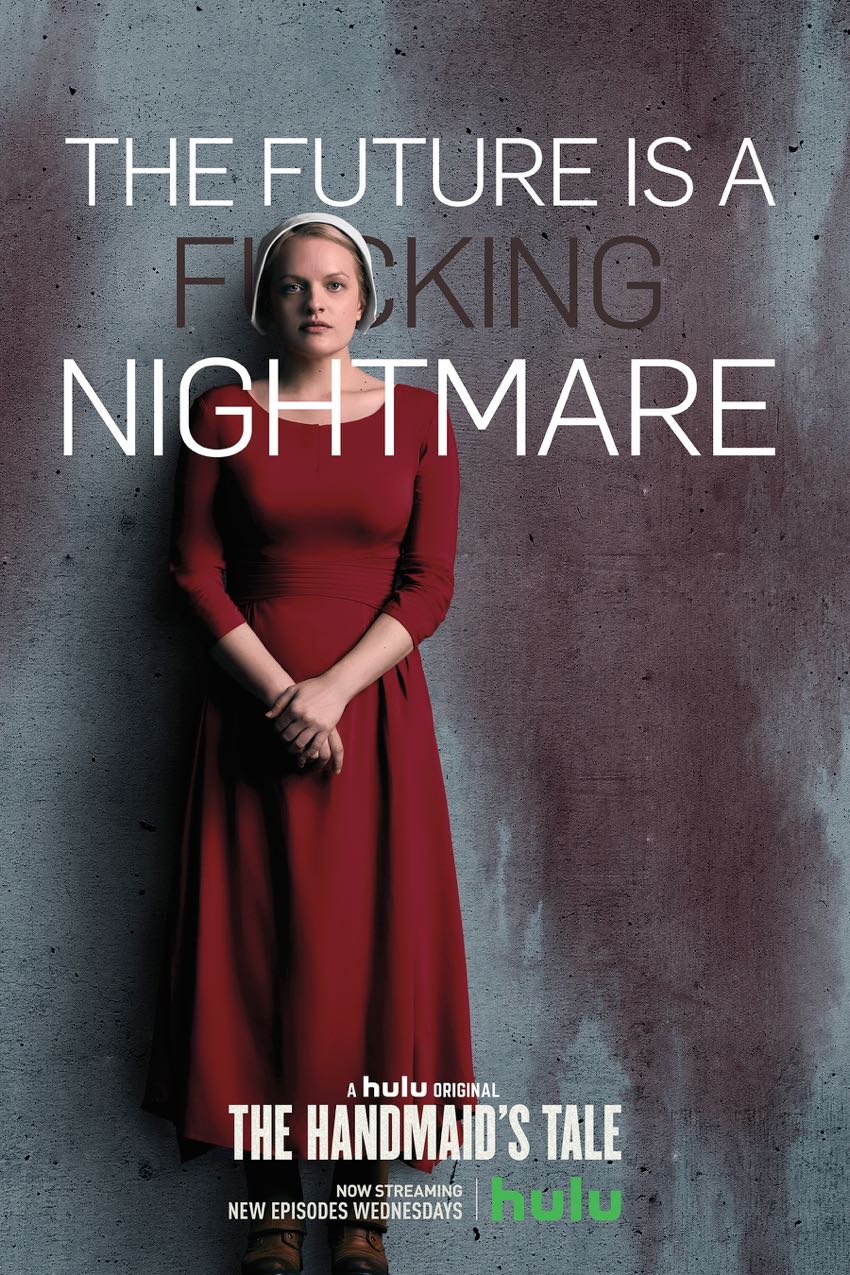
We began with genocide, and ended with a contemporary analysis of Hulu’s rendition of the 1985 feminist classic, The Handmaid’s Tale. Written by Margaret Atwood, the book was an essential read for GenX feminists. I always tried to get through it, but I found the sci-fi dystopia too obvious and too extreme. I don’t like gratuitous violence in film for the same reason. Why would I choose to subject myself to more blood in a society that, in reality, was already saturated in it? For feminist sci-fi, I wanted Herland, written by Charlotte Perkins Gilman in 1915, it is a utopia, that teaches readers how patriarchal visions of the world are all in the mind.
So the prompt I wrote for the final paper on the Hulu series, which began in 2017, went something like this: Why did Hulu producers find Atwood’s book an important tale for the historical moment?
Earlier in the semester, students read and discussed either Herland or Octavia Butler’s Wild Seed (written in 1980), so I also asked, why not do a series on one of these equally famous feminist sci-fi texts? Finally, I brought the insidious use of propaganda into the paper prompt: What is the media preparing us for in their film production of The Handmaid’s Tale? And can you connect the themes of bodily/reproductive control in the book and Hulu series to contemporary politics?
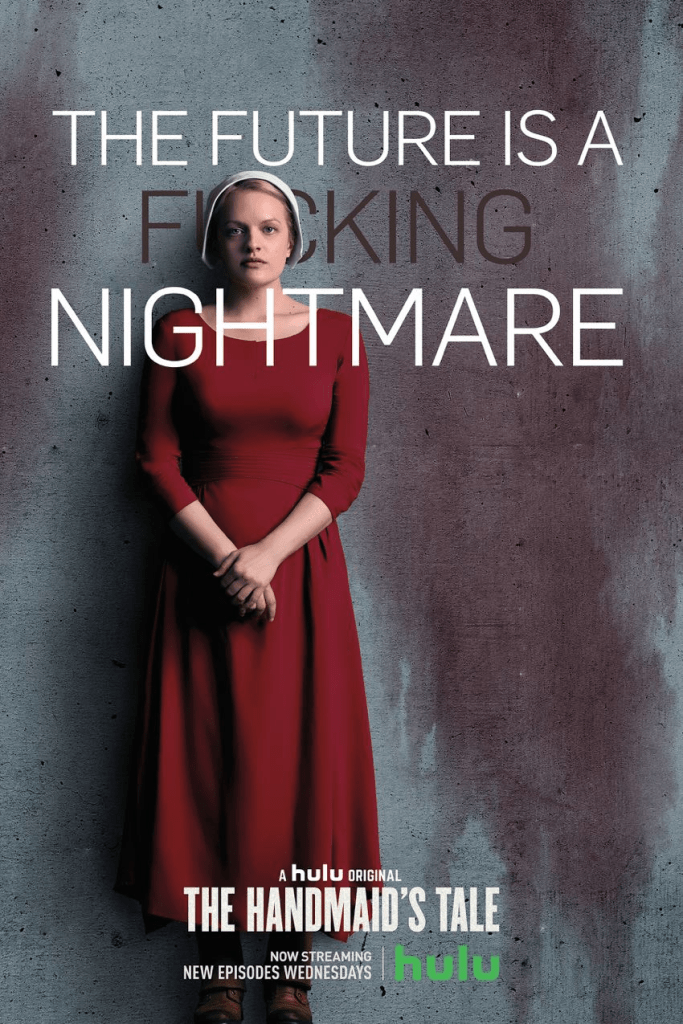
Above: The Handmaid’s Tale, promotional image for season 1, https://cinemovie.tv/images/stories/Movie%20Pics/CSSgallery/HandmaidsTalePosters/Handmaids_Tale_Hulu_Character_Posters_-_1.jpg (accessed August 17, 2024)
When I wrote the prompt, I wasn’t thinking that Roe v. Wade would be struck down in six years, but I had been both victim and witness to the hatred and violence against female and women-identified bodies. I couldn’t have known that the COVID-19 pandemic would make control of bodies–with new, barely tested vaccines being pumped into (or not pumped into) them willingly and unwillingly, and quarantines, stay-at-home orders, and travel bans restricting people’s bodily boundaries and movements, de rigueur.
But for many years, I began to see the ways in which female bodies–women of all backgrounds, are disposable in violent, misogynist patriarchy. In Cleveland, in 2010, Angel Bradley-Crockett was murdered for her clothes and jewelry by a couple after a minor traffic accident near West 44th Street in Cleveland. The couple then dumped Bradley-Crockett’s body on I-90 west, as if she was nothing. Underscoring the indignity of their acts, two Cleveland Police officers drove by her body without stopping, identifying it as a dead deer, even as the motorist reporting it at 4:15 a.m. noted that it was a human body.
The consciousness-raising group I was a part of at the time created signs and posted them at the site of where Angel Bradley-Crockett’s body was found. I think of her even now, every time I drive west on 90 and go past the overpass that says “Lorain Ave.,” as it was there, precisely, that she was found, stripped of everything.
In a letter to Scene, I asked if the horror that Ms. Bradley-Crockett went through, the disregard for her very being was something I had to warn my kids about, my women’s and gender studies students, that it would be normal to find extinguished female bodies on our streets?
The next week a man wrote responded to my question, saying it was ridiculous and he was going to use my letter (the paper on which it was printed) to catch droppings in his indoor bird cage.
Yet, a year before Bradley-Crockett’s murder, Anthony Sowell murdered 11 women in Cleveland, storing their bodies in his house on Imperial Avenue.
In the next 15 years, there would be so many murders.
A beloved writer and community member, Nikki Delamotte, murdered in November 2018 by an uncle she was visiting for the first time in years. He shot her three times in the side, chest, and head, before shooting himself in the head.
Below: Nikki Delamotte: Kind, funny, dedicated friend, excellent arts and culture writer, trenchant news reporter, lover of cats

There’s the senseless, unsolved murder of my sister Linda’s daughter in Cleveland, in October 2020. Mee Mee was standing outside with friends at an afterhours club, celebrating a birthday. Her life ended simply because she was standing between the club and a man. He was angry that security wouldn’t let him in, so he shot toward the crowd on the way out. Another person was shot in the leg and recovered, physically at least.
These traumas we are living are real.
It’s on us to stop them.
Tomorrow night’s vigil is in Stow, Ohio and for Megan Keleman, who, on Wednesday, August 14, was murdered for pulling in front of a known violent alcoholic white man in the drive-thru of Taco Bell. For pulling in front of him in the fast food line, she lost her life. Megan just finished a Master’s degree, the picture of her circulating online is of her the graduation gown, her sweet one-year-old pup by her side.
Just an ordinary day…
***************************
I return to the Hulu prompt, to the letter from the man who thought my question about the future of violence against women, females, queers, and people of color was worth his bird shitting on it, and to the roles we all play in perpetuating this violence.
First and foremost, the media–Netflix, Amazon, Hulu, YouTube, TikTok, Facebook, X, etc., are all training us to accept this violence.
Cases in point:
American Murder: Laci Peterson (Netflix)
American Nightmare (Netflix)
Homicide Los Angeles (Netflix)
Depp v. Heard (Netflix)
Lover, Stalker, Killer (Netflix)
Monster: The Jeffrey Dahmer Story (Netflix)
Immaculate (Hulu)
Secrets of the Chippendales Murders (Hulu)
Cold Case Files (Hulu/A&E)
Road Wars (Hulu/A&E)
Making a Monster (Amazon Prime)
Inside the Mind of a Serial Killer (Amazon Prime)
Pillowcase Murders (Amazon Prime)
Becoming Evil: Serial Killers Among Us (Amazon Prime)
Oh, and The Handmaid’s Tale wraps up on Hulu next year with season 6.
In providing this list, I’m adding to my WGS critical essay prompt. It appears that media moguls are feeding us what we’re living–violence, murder, abuse, bodily oppression, as entertainment. Preparing us for more.
And we pay them for it.
One way to curb the gun violence and these random murders (aside from getting rid of guns and destroying white patriarchy) is to unlearn what they’ve been teaching us on television, movies, videogames, and now on streaming services and social media: women, females, queers, and people of color are disposable.
This is not normal.
Entire shows are devoted to murders of us, with scenes of men–usually white ones, dissecting us, abusing us, reminding us how easily we can be replaced.
Unlearn these lessons.
Turn off your screen.
Watch your favorite film instead.
Read a book about a powerful female, woman, queer, and/or person of color. Talk about them at the water cooler instead of the violence they want us to accept.
Love, DRB
[1] Silvia Federici, Caliban and The Witch: Women, The Body, and Primitive Accumulation (Autonomedia, 2004/2014), 162-217.
 Eradicate the Patriarchy
Leave a comment